Built for the devices that leave the building.

Scanners, phones and tablets in the hands of people doing a job, not laptops on a desk. Different industries, different roles, the same record of what happened.

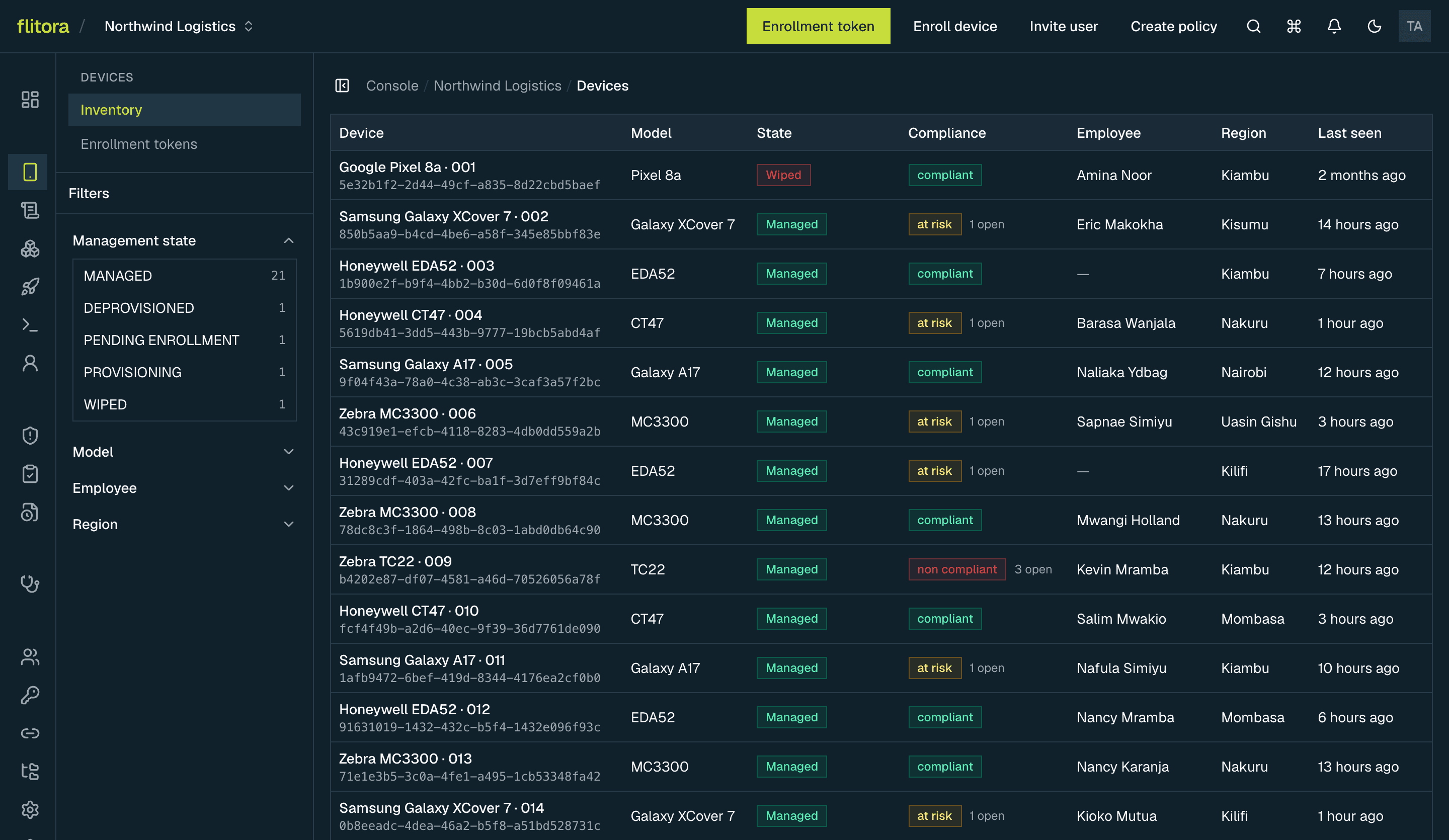
The Mobidachi console listing one fleet's mixed hardware together — Pixel and Galaxy phones beside Honeywell and Zebra rugged scanners — each row giving the device's region across Kiambu, Kisumu, Nakuru, Nairobi, Uasin Gishu, Kilifi and Mombasa, and how long ago it last reported.
Two ways in

Does this fit us?

Answered both ways round. The business you run, and the seat you will sit in.

Retail

Shop-floor tablets and handheld scanners across branches, used by staff who change often.

A device walks out with a leaver and nobody notices until stocktake. A new branch opens and its tablets are configured from memory, differently.

  • New branch devices enroll from a printed code and inherit the branch policy
  • A lost device is locked and marked from the console, not chased by phone
  • Every device shows which employee holds it and which branch it belongs to

Logistics and delivery

Driver handsets running a proof-of-delivery app, out of the depot all day.

The delivery app updates and half the fleet is still on last month's version, because updating means the handset coming back to the depot.

  • App versions pushed by rule, with per-device rollout results
  • Handsets locked to the apps the job needs and nothing else
  • Last-seen times that tell you which devices never came back

Warehousing

Rugged scanners on shift rotation, shared between people rather than owned by them.

Shared devices drift out of configuration one setting at a time, and the drift is only discovered when a shift cannot scan.

  • Policy re-applied continuously, not just at setup
  • Compliance violations raised as incidents before a shift is blocked
  • Battery and storage telemetry on the device record

Field service

Engineer devices carrying customer data into places you do not control.

A device is lost on site with job data on it, and the only available response is hoping the passcode holds.

  • Remote lock and wipe, re-authenticated at the point of use
  • Encryption and passcode strength enforced by policy, not by asking
  • A written record of who did what to which device, and when

One business, or many.

The same console runs a single fleet and a portfolio of them. Which one you are does not change how the product works, only how much of it you see.

One business

A single tenant with its own devices, policies and administrators. The common case, and the simplest.

  • One Android Enterprise binding, done once
  • Roles scoped to your organisation only
  • Your audit trail, visible to your auditors

Many businesses, one operator

For a managed service provider, or a group running several trading companies. Each business is its own tenant, and operators move between them on purpose.

  • Tenants provisioned, suspended and reactivated from a platform console
  • Cross-tenant audit for the operator, per-tenant audit for each business
  • The active tenant is on screen at all times, so a policy cannot be pushed to the wrong fleet

A customer story goes here.

Empty on purpose. We have no customer to write about yet, and making one up is the fastest way to lose a sale. Replace this section, copy and image together, once there is a real deployment to talk about.

solutions-case-study

Case study image. LEAVE EMPTY until there is a real customer to write about.

1200 × 800

Tell us what your fleet looks like.

How many devices, what hardware, and what goes wrong today. We will show you the parts that apply and skip the rest.